sábado, 18 de abril de 2015
Estado de agregación: Gaseoso
Para la materia, Físico Química, tuvimos que buscar en nuestras casas cosas que encontremos o solidas o liquidas o gaseosas y fotografiarlas. Luego había que hacer una especie de presentación en la cual introduzcas esas imágenes y las características del estado que elegimos. Aquí esta mi presentación, la cual elegí el estado Gaseoso:

domingo, 12 de abril de 2015
Describing the Tsar
In this work, what we have to do was think about 20 words ,aproximatly, that describes Tsar Nicholas II and present them in Word Salad or Tagxedo.

miércoles, 25 de marzo de 2015
Caperucita y el tigre
Caperucita y el Tigre:
Había una vez una niña muy curiosa e inteligente de 14 años de edad. La llamaban Caperucita Roja ya que nunca salía de su hogar sin su caperuza roja, que se la había hecho su abuela Norma.
Una tarde de mucho calor recibe un llamado. Su abuela había desaparecido. Ella, muy preocupada se dirigió a lo de Norma sin el permiso de su madre, que estaba haciendo la denuncia en la comisaría.
Caperucita ,extremadamente nerviosa, llega a la casa de su abuela. Se desesperó al encontrar sangre en el piso. Entonces, rápidamente va al cuarto de Norma y halla la ropa destrozada de su abuela. De pronto un feroz tigre, anaranjado, hambriento y enorme se lanza hacia ella y la de devora al instante.
Tiempo más tarde llega la madre, un médico forense y la policía. Ellos encuentran que el tigre había entrado por la ventana de la cocina, que Norma siempre dejaba abierta para ventilar la casa.

jueves, 19 de marzo de 2015
Tsar Nicholas II
In the classes of history, we are learning about a Tsar called Nicholas II. My friend and I made a popplet that talk about him. Here I leave it.
jueves, 27 de noviembre de 2014
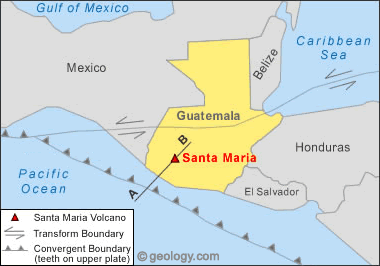
Santa Maria: a catastrophe that lasted three days.
In the morning of the 24 October,1902, a volcanic eruption took place in Santa María, Guatemala. The eruption lasted three days( from the 24 to the 26), and the scientist Dr. Franklin answered some questions such as why the volcano erupted, and why the ashes could arrive in San Francisco, USA. He answered that the Santa María had clearly exploded as a consequence of a seismic sward that had taken place in that region in January of that year which included a major earthquake in April.
The volcano killed lots of people in Guatemala, this was for example because there were so many ashes that they got the throatsof the people. Also he explained that the ashes arrived at USA because the wind was in direction to the north.
Finnaly, the eruption was over in the morning of the 26th. The people who survived were very happy.
Questions
1- What happened? A volcanic eruption.
2-Where? In Guatemala, Santa Maria, Santiaguito.
3- When? The 24, 25 and 26 of October, 1902.
4-Who were involved? Many people were involved in Guatemala. Also the ashes were detected in San Francisco, United States.
5- Why? The volcano awaking was clearly indicated by a seismic swarm in the region in January of 1902, which included a major earthquake in April.
Interview
Today we will interview Alex Vunection, a surviver of the .
volcanic eruption in Guatemala in 1902. He is 90 years old.
Me: Which was your first reaction when yo heard the explosion?
Alex Vunection: Well, the first thing I imagined was a big bomb, my wife was in another country si I had to take care of my daughter. I ran to her bedroom and took her with me. Then I looked trought the window and I could see the big mountain that was far from my house. I felt terrified, I ran out of my house, but when I opened the door, with my little daughter in my arms the ashes started to fly into my eyes. I ran again into my house , now my babe was crying, and me thinking abou my death, I hid under the bed. After the hours passed, the climate was changing into good. Then I stood up again, I covered my daughter with all the things I could found and started running out of my house with the ashes covering my feets. When I was very far away, I found a house where a family assited us very well.
Me: Tell me about what happened the next day. Where did you go? Did the weather get worst?
Alex Vunection: The next day, we got up and I wanted to go to another place, I didn't know which, but very far away from there. When we went down to the kitchen, we could see through the window a view full of ashes so I couldn't go anywhere with my babe. The family offered me to stay the time I wanted, so I stayed there one more day in which the weather became worse. In the 26 the weather got better, and I called my wife, who was coming and I told her were I was and what had happened.
Me: What did you think when everything had finished?
Alex: I felt very distressed because of all the people who died because of the eruption, the things I lost like my house, and a lot of things more that now become impossible for me to imagine them. Apart from these feelings I also felt a little happy for my family and myself, we could return altogether again.


The volcano killed lots of people in Guatemala, this was for example because there were so many ashes that they got the throatsof the people. Also he explained that the ashes arrived at USA because the wind was in direction to the north.
Finnaly, the eruption was over in the morning of the 26th. The people who survived were very happy.
Questions
1- What happened? A volcanic eruption.
2-Where? In Guatemala, Santa Maria, Santiaguito.
3- When? The 24, 25 and 26 of October, 1902.
4-Who were involved? Many people were involved in Guatemala. Also the ashes were detected in San Francisco, United States.
5- Why? The volcano awaking was clearly indicated by a seismic swarm in the region in January of 1902, which included a major earthquake in April.
Interview
Today we will interview Alex Vunection, a surviver of the .
volcanic eruption in Guatemala in 1902. He is 90 years old.
Me: Which was your first reaction when yo heard the explosion?
Alex Vunection: Well, the first thing I imagined was a big bomb, my wife was in another country si I had to take care of my daughter. I ran to her bedroom and took her with me. Then I looked trought the window and I could see the big mountain that was far from my house. I felt terrified, I ran out of my house, but when I opened the door, with my little daughter in my arms the ashes started to fly into my eyes. I ran again into my house , now my babe was crying, and me thinking abou my death, I hid under the bed. After the hours passed, the climate was changing into good. Then I stood up again, I covered my daughter with all the things I could found and started running out of my house with the ashes covering my feets. When I was very far away, I found a house where a family assited us very well.
Me: Tell me about what happened the next day. Where did you go? Did the weather get worst?
Alex Vunection: The next day, we got up and I wanted to go to another place, I didn't know which, but very far away from there. When we went down to the kitchen, we could see through the window a view full of ashes so I couldn't go anywhere with my babe. The family offered me to stay the time I wanted, so I stayed there one more day in which the weather became worse. In the 26 the weather got better, and I called my wife, who was coming and I told her were I was and what had happened.
Me: What did you think when everything had finished?
Alex: I felt very distressed because of all the people who died because of the eruption, the things I lost like my house, and a lot of things more that now become impossible for me to imagine them. Apart from these feelings I also felt a little happy for my family and myself, we could return altogether again.

Taller Itinerante "Pensa Antes de Tirar"
Como una integración de nuestro proyecto en Construcción de la Ciudadanía, "Pensa Antes de Tirar", tuvimos que realizar un video que muestre en fotos y palabras todo lo que hicimos en el año como cuando fuimos a las guarderias..
lunes, 24 de noviembre de 2014
Hongout a África
El día martes 21 de Octubre realizamos un hangout con un médico argentino llamado José Vega, padre del colegio, que está en Guinea Ecuatorial, Mongomo. Nosotros le hicimos preguntas cómo cuál era la enfermedad más frecuente y es Paludismo pero también nos contó que son muy frecuentes los accidentes automovilísticos. La enfermedad más grave que atendió fue una niña de seis años que tenía un tumor en uno de sus pulmones.
Lo que más queríamos saber era si él atendía a pacientes con ébola pero no lo hace. Él trabaja en una clínica llamada "Policlínico Virgen de Guadalupe" en el cual atiende a personas de clase media o alta, la clínica es privada.
Queríamos saber que se hace con un niño que sufre desnutrición y aprendimos que lo primero que se tiene que hacer es darle agua y no mucha comida de repente para que el estómago se acostumbre. Igualmente José no atiende ese tipo casos.
Él trabaja con dos enfermeras cubanas y otros médicos de diferentes países.
Suscribirse a:
Entradas (Atom)